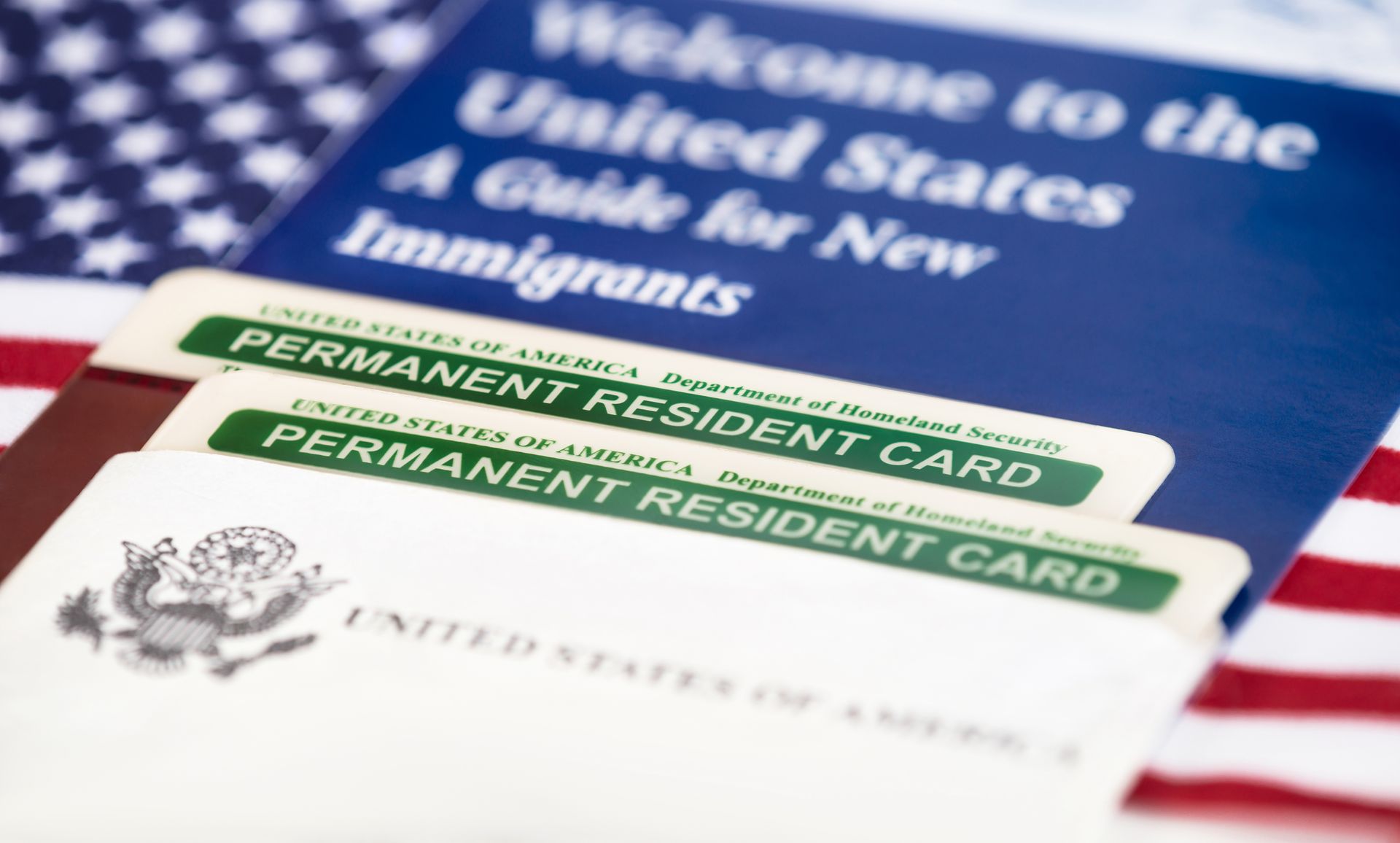

Employment-Based Green Cards: EB-1, EB-2 & EB-3
Employment-Based Green Cards Explained: EB-1, EB-2, and EB-3

For many foreign professionals, whether skilled, unskilled, or employed in specialized roles and for the U.S. employers seeking to hire them, the path to permanent residency often begins with an employment-based green card. These categories allow eligible workers to live and work in the United States permanently, rather than relying on temporary visas that eventually expire.
This guide breaks down what each category generally involves and how the process typically works.
What Is an Employment-Based Green Card?
An employment-based green card grants lawful permanent residency based on a person's work, experience, skills, or professional achievements. It differs from a temporary work visa, such as an H-1B, E-2, L-1, or O-1, which authorizes someone to work in the U.S. for a limited period and must eventually be renewed or converted to another status.
A green card, once approved, allows the holder and their family members to live and work in the United States permanently, with a pathway toward U.S. citizenship down the road. Employment-based green cards are organized into preference categories, commonly labeled EB-1 through EB-5, based on the type of work, qualifications, or investment involved. This article focuses on the three employment-based categories most commonly encountered by professionals and skilled workers: EB-1, EB-2, and EB-3.
EB-1 Green Card
EB‑1 is the first‑preference employment‑based green card category reserved for individuals at the very top of their fields. It provides a path to U.S. permanent residency for three types of applicants: extraordinary ability individuals (EB‑1A), outstanding professors and researchers (EB‑1B), and multinational executives and managers (EB‑1C).
EB-1A: Extraordinary Ability
This subcategory is for people who have reached the top of their field, whether in science, education, business, athletics, or the arts. Applicants generally need to show sustained national or international acclaim through evidence such as major awards, published work, or a track record of significant contributions to their field. One notable feature of EB-1A is that, in many cases, it does not require a job offer or employer sponsorship.
EB-1B: Outstanding Professors and Researchers
This subcategory applies to academics and researchers who are internationally recognized in a specific field. Unlike EB-1A, this category typically requires a job offer from a qualifying employer, such as a university or research institution, along with evidence of at least three years of teaching or research experience.
EB-1C: Multinational Managers and Executives
This subcategory is designed for executives or managers who have worked for a qualifying multinational company abroad and are transferring to a related U.S. entity in a managerial or executive capacity. It generally requires employer sponsorship and evidence of the qualifying employment relationship abroad.
Because these three subcategories correspond to very different applicant profiles, it is important to determine early on which one, if any, aligns with your background.
EB-2 Green Card
EB-2 is generally intended for professionals with advanced degrees or individuals with exceptional ability in their field. This category also has a few different paths within it.
Advanced Degree Professionals
This applies to individuals who hold a U.S. master's degree or higher, or a foreign equivalent, in a field relevant to the job being offered. In some cases, a bachelor's degree combined with a specified number of years of progressive work experience can also qualify.
Exceptional Ability
This applies to individuals with a level of expertise significantly above what is normally encountered in their field, demonstrated through evidence such as advanced degrees, licenses, memberships in professional associations, or a record of notable achievement.
National Interest Waiver (NIW)
Some EB-2 applicants may qualify for a National Interest Waiver, which allows them to bypass the standard labor certification and, in many cases, self-petition without an employer's sponsorship. This option is generally available to individuals whose work is considered to be in the national interest of the United States, such as certain research, technology, science, engineering, or public health contributions. Eligibility for an NIW depends on meeting specific legal criteria, so not every advanced degree professional will qualify. For a closer comparison of this path against EB-1A, see our guide on EB-2 NIW vs. EB-1A.
EB-3 Green Card
EB-3 covers a broader range of workers and is divided into three subcategories.
- Professionals: Positions that require at least a U.S. bachelor's degree, or a foreign equivalent, and where a bachelor's degree is the normal requirement for entry into the occupation.
- Skilled Workers: Positions that require at least two years of training or work experience.
- Other Workers: Positions that require less than two years of training or experience, sometimes referred to as unskilled labor.
Most EB-3 cases require employer sponsorship, and many also require a PERM Labor Certification. PERM is a process in which the employer must demonstrate to the U.S. Department of Labor that no qualified, willing, and available U.S. workers are available for the position and that hiring the foreign worker will not negatively affect the wages or working conditions of similarly employed U.S. workers.
EB-1 vs. EB-2 vs. EB-3
Here is a general comparison of how these three categories typically differ. Keep in mind that individual cases can vary depending on specific circumstances.
Process Features
EB-1
EB-2
EB-3
Typical eligibility
Extraordinary ability, outstanding researchers, or multinational executives/managers
Advanced degree professionals or those with exceptional ability
Professionals, skilled workers, and other workers
Employer sponsorship
Generally required for EB-1B and EB-1C; not required for EB-1A
Generally required, except in NIW cases
Generally required
PERM requirement
Not required
Required unless a National Interest Waiver applies
Generally required
Self-petition possibility
Often possible for EB-1A
Possible in NIW cases
Not possible
General applicant profile
Individuals with top-tier achievements or senior multinational roles
Professionals with advanced degrees or specialized expertise
Workers across a wide range of skill levels and occupations
Because eligibility standards and documentation requirements can differ from case to case, this table should be treated as a general starting point rather than a definitive answer for any individual situation.
What Is the Employment-Based Green Card Process?
While the exact steps depend on the category and the applicant's circumstances, most employment-based green card cases move through some version of the following stages.
Stages of the Employment-Based Green Card Process
- Determining eligibility. Identifying which category, if any, fits the applicant's background and job offer.
- Labor certification, when required. Employers in most EB-2 and EB-3 cases must complete the PERM process before filing a petition.
- Filing the immigrant petition. The employer, or in some cases the applicant, files a petition with USCIS.
- Visa availability. Depending on the applicant's country of chargeability and category, a visa number may need to become available before the case can move forward.
- Adjustment of Status or Consular Processing. Applicants already in the U.S. may apply to adjust their status, while those abroad typically go through consular processing at a U.S. embassy or consulate.
- Green Card approval. Once all requirements are met and a visa number is available, USCIS can approve the applicant for permanent residency.
Because each category has its own requirements, and because factors such as country of origin, current immigration status, and job-specific details all influence eligibility, the path forward can look very different from one applicant to another.
How Long Does an Employment-Based Green Card Take?
Processing times for employment-based green cards vary widely and depend on several factors, including:
- Which EB category applies
- Whether PERM Labor Certification is required
- The applicant's country of chargeability, since visa availability can differ significantly by country
- Current USCIS processing volumes
- Whether the case involves adjustment of status or consular processing
Because these factors change over time and differ by case, it is not possible to provide a guaranteed timeline. Checking the U.S. Department of State's Visa Bulletin and USCIS processing time data can offer a more current picture for a specific category and country.
Common Challenges With Employment-Based Green Cards
Several issues tend to come up repeatedly in employment-based green card cases, including:
- Choosing the wrong category. Applying under a category that does not match the applicant's actual qualifications or job duties.
- Incomplete documentation. Missing or insufficient evidence to support the claimed eligibility.
- PERM-related issues. Errors in the recruitment process or job posting requirements that can affect the labor certification.
- Visa number availability. Long waits for certain categories and countries due to annual visa limits.
- Changing employment circumstances. Job changes, layoffs, or changes in job duties that can affect an ongoing case.
- Inaccurate or inconsistent information. Discrepancies between the petition, supporting evidence, and other immigration filings.
Identifying these issues early can help prevent delays or, in more serious cases, a denial.
When Should You Speak With an Employment Immigration Attorney?
Employment-based green card cases can involve detailed eligibility questions, especially for categories like EB-1A or EB-2 NIW, where the applicant must build a case around their own achievements rather than relying solely on an employer's sponsorship. Legal guidance can also be useful for employer-sponsored cases involving PERM, situations with unusual employment histories, or cases where a change in job duties or employer could affect an existing petition.
Garcia Immigration Law, LLC, based in Orlando, Florida, works with professionals and employers on a range of immigration matters, including employment-based cases. Attorney Anna Garcia helps clients evaluate their options and understand what a specific case may require, based on their individual background and goals. If you want to explore how these categories might apply to your situation, a case evaluation with our firm can help you understand which path may fit your qualifications, your employment situation, and your long-term plans.
Conclusion
EB-1, EB-2, and EB-3 each serve distinct types of applicants, from individuals with extraordinary achievements to professionals and skilled workers filling specific job roles. The right category depends on your qualifications, your job offer (if applicable), and sometimes your ability to self-petition. Understanding these differences before choosing a pathway helps avoid unnecessary delays and set realistic expectations for the process ahead.
If you are a professional exploring your options, or an employer considering sponsoring a foreign worker, contact Garcia Immigration Law at 407-674-9535 to discuss your specific circumstances with our Attorney Anna Garcia.
Frequently Asked Questions
What is the difference between EB-1, EB-2, and EB-3?
EB-1 covers extraordinary ability, outstanding researchers, and multinational executives. EB-2 covers advanced degree professionals and those with exceptional ability. EB-3 covers skilled workers, professionals, and other workers.
Do I need an employer to sponsor my employment-based green card?
Usually yes, but not always. EB-1A and EB-2 National Interest Waiver cases may allow you to self-petition without a job offer.
What is PERM Labor Certification?
It is a process where an employer proves to the U.S. Department of Labor that no qualified U.S. workers are available for the position. Most EB-2 and EB-3 cases require it, but EB-1 and EB-2 NIW cases do not.
What is a National Interest Waiver?
It is an option under EB-2 that lets certain applicants skip labor certification and often self-petition, based on how their work benefits the national interest.
How long does the employment-based green card process take?
Timelines vary by category, country of chargeability, PERM requirements, and USCIS processing volumes. There is no set or guaranteed timeframe.
Can I change jobs while my employment-based green card case is pending?
It depends on your case stage and category. Because a job change can affect a pending petition, consult an immigration attorney before making any employment changes.
What happens if I choose the wrong EB category?
It can lead to delays or a denial. Confirming the right category early helps avoid this.
Do all employment-based green cards lead to the same outcome?
Yes, all lead to permanent residency, but eligibility rules and sponsorship requirements differ by category.